
May 26, 2025
I am no stranger to a long drive. I once drove nine hours to South Bend, Indiana, with only one stop for gas. I did the same on a ten-hour drive to Montreal. On both occasions, however, I had companions. This journey to Rhode Island will be the longest drive I’ve ever made alone, much to the worry of Mami.
I understand her apprehension. My mother and I come from very different worlds when it comes to travel. For starters, she grew up in a time and place where young girls were not afforded the freedom to wander about as they pleased. In her family, she wasn’t allowed to go anywhere alone unless accompanied by an older male relative. Given the expectations placed upon women in the rural Dominican Republic of the 1970s, her caution is understandable. In her mind, traveling anywhere more than an hour away by yourself is a risky endeavor, let alone driving to an unfamiliar state more than five hours from home.
Then there are the logistics. Plenty can go wrong on a long drive. I could get a flat tire, experience mechanical trouble, or find myself in an accident. I have a tendency to overthink many things in life, but travel isn’t one of them. I rarely anticipate the worst, which could very well be to my detriment someday. I simply don’t enjoy operating under the assumption that disaster might be waiting around every corner. That’s an exhausting way to live.
I know next to nothing about cars, but I keep up with Juvia’s maintenance appointments, and that’s enough to give me peace of mind. Anything else is a bridge I’ll cross when I get there. Literally, if necessary.
Perhaps some of the difference between my mother’s outlook and mine comes down to how much easier travel has become. Saying that Mami grew up in the sticks would be an understatement. I usually tell people she grew up like Pocahontas. Her family lived among wooded mountains and rivers in the Cibao region of the Dominican Republic, without electricity or many of the conveniences I take for granted. Traveling to the nearest town meant undertaking a literal hike against the forces of nature.
One family story involves my great-grandmother spotting a boy drowning in a river near their home. She rushed to save him, only to discover that the boy was her own grandson, my uncle.
Another story came to me recently through my aunt’s husband, who casually recalled a time when the family ate something bad and ended up with parasites. I found the story amusing, partly because I could sense my aunt’s embarrassment. She had the unmistakable expression of someone wondering, Why on earth would you bring that up?
But beneath the humor, I felt a little sadness.
If you met my family today, you might never imagine the circumstances from which they came. We’re by no means rich, but we’re comfortable enough that our beginnings are not immediately apparent. Stories like the one about the parasites make me wonder what other hardships my elders endured that they would never dare tell us.
And here I am, driving through the northeastern United States with air conditioning, a smartphone, roadside assistance available if I need it, and gas stations never too far away.
We’ve got it pretty good.
I don’t mean that traveling alone is without risk. I simply trust that if something goes wrong, I’ll have ways to deal with it. For now, I have a full tank of gas, a healthy Camry, and a destination. That’s enough for me.
Pennsylvania is always such a pleasant state to drive through. Having spent most of my life here, I took its beauty for granted. It wasn’t until that aforementioned road trip to Indiana that I truly began to appreciate it. After hours upon hours of driving through the comparatively flat landscapes of Indiana and Ohio, I started feeling as though I were trapped in a video game whose simulation kept rendering the same scenery. Corn fields, highways, more corn fields, more highways. I began to suspect the developers had run out of ideas.
When I finally crossed back into Pennsylvania and saw the mountains again, I nearly cried tears of joy. It’s as if I was subjected to eating bland French fries for a time and finally got access to salt again.
No matter where I’m traveling from, there’s something profoundly comforting about crossing into Pennsylvania. Borders fascinate me. They’re essentially human inventions, lines drawn across landscapes that have no inherent obligation to acknowledge them. Yet their psychological power is extraordinary.
How is it that crossing an imaginary line and seeing a sign welcoming me to Pennsylvania can calm my nervous system as though I’ve just walked through my front door?
Of course, today I’m traveling in the opposite direction. And I won’t be returning for at least three months.
The first leg takes me from Reading toward New York City, a journey I’ve made hundreds of times. Driving these roads feels like rewatching a familiar movie. I know the scenes that are coming, and nearly every one carries some memory.
Along Route 222, I pass near my alma mater, Kutztown University. It wasn’t all that long ago that I left home for the first time in nearly twenty years to live on campus as a junior transfer student. My newfound independence was short-lived. During my second semester, COVID took the world by storm, and I found myself returning home.
Continuing northeast, I approach the Allentown area, where the roller coasters of Dorney Park announce a different kind of nostalgia.
My first visit to Pennsylvania was in 1999, when my family came from New York City to visit my Tío Lucho. He had moved to Reading before the rest of us, pioneering the way for the family members who would eventually follow. During that visit, we went to Dorney Park. It remains one of the earliest vivid memories I can recall.
It’s strange how an amusement park can serve as a landmark in the geography of one’s life. To the thousands of motorists passing through, those roller coasters are little more than a roadside attraction. To me, they’re a reminder of a childhood that seems both impossibly distant and strangely close.
Eventually, I make my way onto Interstate 78 East, which carries me toward New Jersey. This stretch is the calm before the storm of the Big Apple. I cross the state line and playfully scoff to myself that I’ve downgraded states. I say this with affection. Between summer trips down to Cape May and my eldest brother living here, New Jersey is rather dear to my heart, too. I liken Jersey to that family member who goes a little too far out of their way to show you all the fancy things they own. I don’t mind it, but there’s something about Pennsylvania’s comparatively humble character that feels more like home.
Eventually, my route brings me to the George Washington Bridge. New York City. Where it all began. It feels appropriate that my journey toward an unfamiliar future should pass through the city of my birth.
I rarely spend time in New York nowadays. I only lived there for the first 8 years of my life before we moved to PA. I did continue traveling back to New York often as my father remained in Queens manning the bodega for a number of years. Though I have long lost my status as a true New Yorker, there is always an enduring seed of the New York state of mind planted from my formative years in Woodside, Queens that is ready to grow the second I am in the city. Something deep in my psyche awakens. Old neural pathways seem to fire again, reminding me of a version of myself I haven’t entirely lost. The Bodega Daze is what I call those years, but those stories are for another time if this project will allow for such.
New York demands a peculiar kind of awareness. You keep your head on a swivel while simultaneously minding your own business. You move with purpose, tolerate an extraordinary amount of noise, and learn to distinguish between the chaos that requires your attention and the chaos that is none of your concern. It’s a Type A way of life, and I can feel it recharging within my bones. As I pass through Washington Heights, I lock onto the road with more vigilance and put on an appropriate soundtrack.
There are few things more satisfying than playing some braggadocious New York boom bap while driving through the city that helped give birth to it. One of my favorites is Joey Bada$$. His music has the right amount of New York authenticity without feeling like a caricature of the city. He’s also about a month younger than me, which gives me a completely irrational sense of kinship with him.
Here we are, two young men from New York, born within weeks of each other, taking very different roads through life. One became a celebrated rapper. The other is driving a Toyota Camry to Rhode Island to sterilize surgical instruments. I wonder if we have ever crossed paths before unknowingly. I think about that for all the juggernauts of hip hop that were around me.
Surprisingly, traffic isn’t too bad. I make my way across the bridge and through the Bronx on I-95, heading toward Connecticut. This is where the familiar begins to give way to the unknown.
Interstate 95 itself offers one last thread of familiarity. I lived near it in Philadelphia and used it regularly for my commute to work. It’s funny how a highway can become part of your personal geography, even when it stretches far beyond the little section you’ve come to know.
One thing I don’t appreciate is the seemingly endless procession of law firm billboards. Every city appears to have its own collection of attorneys advertising themselves as the hometown champions of the injured and aggrieved. The ads are so carefully tailored to their surroundings that you’d think each lawyer had personally grown up on every street in America.
As I enter Connecticut, traffic takes a turn for the worse. An accident. Google Maps directs me off the interstate and through Stamford, a city I know almost nothing about. My only connection to it is a former coworker who grew up here and recently returned home.
As I navigate the unfamiliar streets, I find myself scanning the surroundings with slightly more interest than usual. I wonder, rather foolishly, whether I might happen to spot those big eyes I remember so easily. Any hint of familiarity along an unfamiliar road is welcome.
Perhaps that’s also why I fell victim to the great American franchise machine. It simply doesn’t feel right to embark on a proper road trip without indulging in some good old-fashioned American fast food. My poison of choice is McDonald’s.
Say what you will about fast food, but there’s something remarkable about being able to walk into a random Mickey D’s in a town you’ve never visited and know almost exactly what to expect. The menu, the smell, the familiar packaging, the comforting predictability of it all. These establishments seem to hold the country together almost as efficiently as they undermine its health.
I order my usual road-trip indulgence: a Double Quarter Pounder with Cheese, medium fries, and the superior fast-food Diet Coke. For a brief moment, all is right with the world. Then I get back on the road.
I’m a patient driver, but I cannot emphasize enough how brutal I find the remainder of the journey through Connecticut. Another accident. Another hour added to my trip.
It’s a shame, really. The coastal corridor along Long Island Sound has its scenic stretches, but it’s difficult to appreciate the landscape when you’re trapped in traffic surrounded by motorists desperately weaving between lanes to gain whatever advantage they can, even if it saves them a single second.
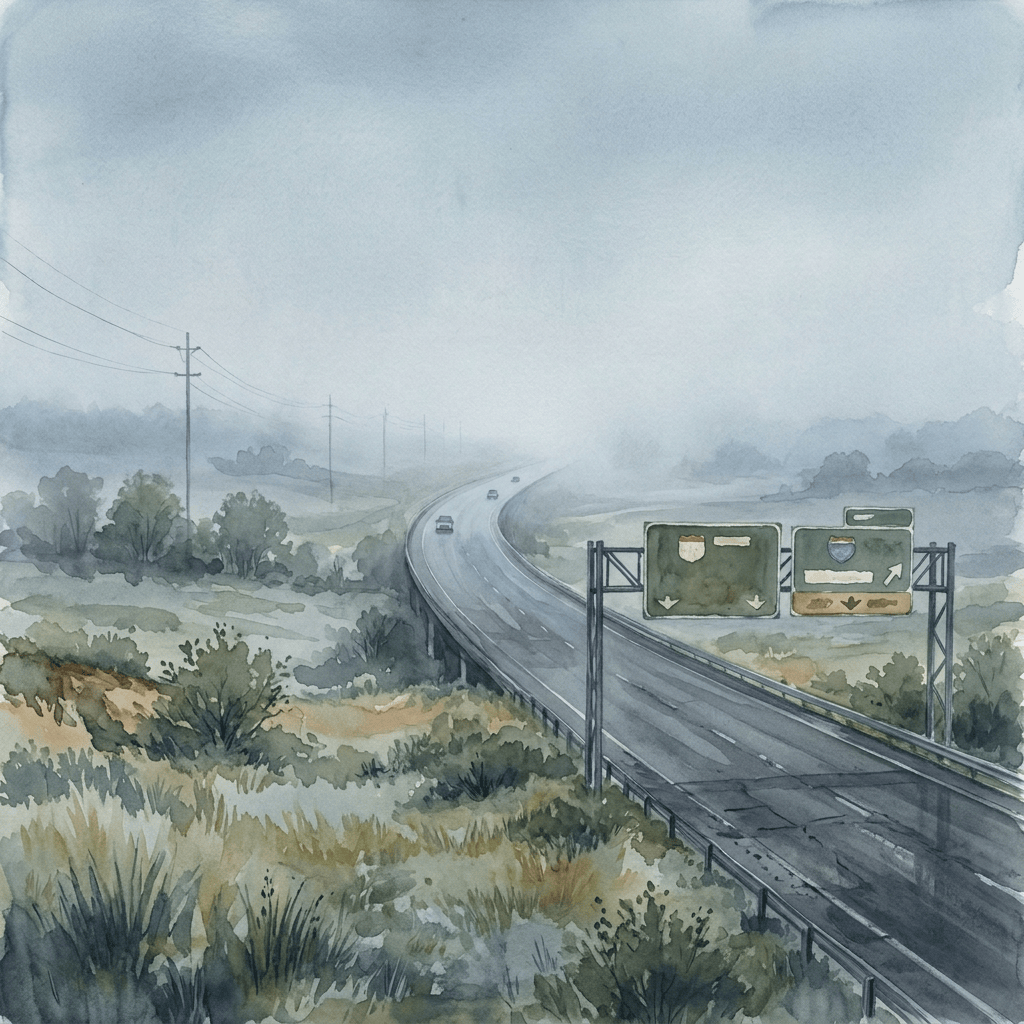
There’s something especially miserable about being stuck on the same interstate for hours. The repetition begins to wear on you. The signs change, the cars around you change, but your circumstances remain stubbornly the same. There’s little I can do except wait.
My usual strategy in these situations is to put on a podcast. Lately, my go-to has been Making Sense with Sam Harris. There’s something about the way Sam approaches difficult subjects that calms me down. He has a measured, analytical style that I find refreshing in an age when so much digital media seems designed to provoke an immediate emotional reaction.
Engaging with online content can be exhausting. Too many creators appear willing to do just about anything for clicks and views, whether that means manufacturing outrage, courting controversy, or burying worthwhile conversations beneath an insufferable number of advertisements.
Sam’s approach feels different to me. His willingness to engage seriously with difficult questions, without relying on the usual attention-grabbing theatrics, has earned my appreciation. Enough, in fact, that I pay for access to his full episodes.
But perhaps the most valuable thing I’ve taken from his work is an appreciation for mindfulness. Being present. Recognizing experience as it unfolds without constantly demanding that it be different. One deep breath through the nose. One slow exhale. And I am back with the Buddha, I tell myself. I return my attention to the moment.
The traffic hasn’t improved. The cars haven’t moved any faster. Connecticut hasn’t suddenly become a more hospitable place to drive. But my relationship to the situation has changed. And in that moment, I’m reminded of something I find particularly beautiful about traveling: the peculiar freedom of being between places.
There’s a word for this condition: liminality.
In anthropology, liminality refers to a transitional state in which someone has left one established position but has not yet fully entered another. The word comes from the Latin limen, meaning threshold. I find the concept especially fitting for a journey like this one.
For these few hours, I’m neither fully attached to the life I’ve left behind nor established in the life waiting for me. The usual expectations have been suspended. I have no coworkers to answer to, no household responsibilities demanding my attention, and no immediate obligation beyond getting myself safely to Providence.
It’s something like a waiting room, except I’m moving through the world rather than sitting still. There is something wonderfully liberating about that. I’ve experienced a similar feeling before, though under very different circumstances.
When I was twenty-one, I began taking classes at Reading Area Community College. I had spent the years following high school feeling somewhat lost, unsure of what direction my life should take. Going back to school gave me something I had been missing: a sense of forward movement.
I didn’t own a car at the time, so whenever my mother’s 2010 Kia Sportage wasn’t available, I walked to class. The journey took about twenty-five minutes and required crossing the Penn Street Bridge, which connected West Reading, where I lived, to the city of Reading.
During those walks, I began experiencing a peculiar sense of euphoria. The peaceful views of the Schuylkill River seemed to heighten it. I’d look out over the water, feel the air against my face, and experience a kind of joy that was difficult to explain. I eventually came to believe that the feeling had something to do with where I was going.
I wasn’t simply walking across a bridge. I was traveling toward a place of learning, a place where I could grow into someone I had not yet become. I enjoy traveling for vacations, of course, but this was something different. The pleasure seemed to run deeper than anticipation or novelty. I felt as though I was on a path of righteousness.
Perhaps the feeling was less about arriving at school than about knowing I was finally moving in a direction that mattered to me. And now, years later, I find myself experiencing a variation of that same sensation on an interstate in Connecticut. Only this time, the destination is far less familiar.
I don’t know what awaits me in Rhode Island. I don’t know the people, the hospital, or the city. I have no established routine, no friends waiting to welcome me, and no real sense of what my days will look like once I arrive. I have my experience in sterile processing, a contract promising considerably more money than I’ve been earning, and an inner drive to survive. That’s about it.
The uncertainty is both liberating and unsettling. I know exactly where I’m going geographically. Google Maps has made sure of that. But as for where I’m going in life, I haven’t the slightest idea. Perhaps that’s what makes this journey so significant to me. For the first time in years, I’m not merely trying to preserve the life I already have. I’m deliberately moving toward one I haven’t experienced.
And for the moment, I don’t need to know how it will unfold. I just need to keep driving. Like all trips of this nature, the journey feels endless until suddenly, in an instant, it doesn’t. At last, another state sign appears. Rhode Island. The Ocean State. My final imaginary line of the day.
As mentioned, though the boundaries of borders are human inventions, the institutions and identities attached to them are very real. Cross one, and you may find yourself subject to different laws, customs, and expectations.
Not that I’ve been misbehaving on the road, but I suppose it’s time to be on my best behavior. After all, this is going to be my home for the next thirteen weeks. I still have some driving to do before reaching Providence, but the end is finally within reach. It’s already around six in the evening, and the day is beginning to wind down.
I feel an urgency to get settled. After all, I have work tomorrow.
For much of the day, I’ve been suspended between two lives, enjoying the peculiar freedom of belonging fully to neither. Now, as Providence draws closer, that freedom is beginning to give way to responsibility.
I came here in search of a new beginning. Tomorrow, I will find out what that beginning asks of me.


Leave a Reply