
September 10, 2026
Today, I’m back at Chattahoochee Food Works, sitting at a more secluded yellow table outside the building. It’s 12:24 p.m., which means I have about an hour before I need to return to my place and get ready for work. I usually leave my room between 2:10 and 2:20 p.m.
My commute takes me onto the I-75 South ramp, then the I-85 North ramp, before I exit onto GA-400 North, where I spend most of the drive. Under favorable conditions, I can make it to St. Joseph’s Hospital in about twenty minutes.
Everyone complains about Atlanta traffic, and I understand the frustration, but I personally find Philadelphia and New York City infinitely worse to drive in. Not once has Atlanta traffic tested my patience to the near-insane levels that Philadelphia and NYC have. I will say, however, that Atlanta’s traffic patterns are far more unpredictable. I also seem to encounter more accidents here. I’m grateful that I haven’t been late for work yet, but every day carries some risk of being late because of how quickly traffic conditions can change.
Part of the problem is the disparity between the city and the metropolitan area. Atlanta proper has a population of roughly half a million, while the greater metro area is home to more than six million people. All those commuters funneling through the same roadways create plenty of opportunities for bottlenecks.
Parking is another headache. Many lots have strange payment systems, and plenty of businesses rely on private companies to enforce their parking rules. Violate those rules, and you might return to find a boot clamped onto your car. Residents have complained that some of these companies are predatory, seemingly waiting for someone to exceed a parking limit so they can swoop in. I’ve been lucky so far, but I’m always wary of what might happen to my car, and I don’t like having to think about it.
Food Works, thankfully, has a much more sensible system. I scan a QR code, register my license plate, and receive two hours of free parking while supporting the businesses inside. No account to create, no additional app to download. Simple. I wish more places operated this way. Supporting local businesses should be as easy as possible, not an exercise in navigating a labyrinth of parking regulations.
It’s 84 degrees and fairly cloudy, so sitting outside feels appropriate. For lunch, I’ve ordered an NYC chopped beef and cheese sandwich, French fries, and a sweet basil lemonade from a burger-and-hot-dog joint suitably named Patty and Frank’s.
I’m not sure why they don’t simply call the sandwich a chopped cheese, which is what it’s known as in New York City. It felt rather awkward having to order a “chopped beef and cheese.” I suppose a literalist might appreciate the name, since it leaves less room for ambiguity. Someone could conceivably hear “chopped cheese” and assume the sandwich consists primarily of cheese.
Specificity in food labeling is rather boring, in my opinion. Imagine if pizza were called baked bread with cheese and tomato sauce. This is essentially my argument in the Caribbean world for why concón is a superior name to pegao, the crunchy rice left at the bottom of the pot. One sounds like a culinary tradition; the other sounds like a description of what happened to the rice.
Anyway, at least the girl taking my order was easy on the eyes.
She had a petite yet athletic frame and a pleasant, attentive face with a golden caramel complexion. She was certainly Latina, a newfound weakness of mine. Despite my proud Dominican background, I’ve never been in a romantic relationship with a Latina. My mother keeps telling me I need a good Dominican girl, and I’m starting to believe she might be right.
What caught my attention most was her single braided ponytail. The ponytail made her look professional and put together, while the braid added a feminine playfulness that struck me as elegant in the manner of a humble Disney princess.
Of course, I made no attempt to charm her. I’m no pickup artist, and I have a strict principle against making advances on someone while they’re at work. Good relationships generally aren’t transactional, and the nature of an interaction between a customer and an employee is about as transactional as it gets. It simply isn’t an ideal environment in which to establish a genuine connection.
Moreover, I happen to like eating here. The last thing I need is for a negative interaction to sour the experience and damage my standing as a regular customer.
On the other hand, if we were potential soulmates, how else would I make an advance without interacting with her at work? My brother met his now-wife while interacting with her as a T-Mobile employee, so it’s not as though these things never happen.
The overarching problem is that I’m merely a traveler. My time in Atlanta is limited. Soulmates or not, what good would it do to pursue something when I might be gone before it has a chance to develop?
It’s difficult to quiet these voices when you’re a man raised in Dominican culture. From a young age, you’re practically beaten over the head with the idea that if you see a girl you like, you go talk to her. Otherwise, you risk bringing shame upon the family by being gay. It sounds wild writing it in English, but these are some of the literal sayings:
“Dile algo, no sea maricón.”
Say something to her. Don’t be a faggot.
Dominicans certainly aren’t alone in this attitude. I recently watched the Italian film Malèna, in which Monica Bellucci plays a woman whose extraordinary beauty makes her the object of desire in a small Sicilian town during World War II. Her husband is away fighting in North Africa, leaving her to navigate a community in which the men lust after her and the women grow resentful of the attention she receives.
I felt strangely at home watching the men pursue Malèna as though their lives depended on it. I even thought I could make out the Italian men commenting on Malèna’s behind, something along the lines of “bel culo!” I couldn’t swear to the exact wording, but the expression sounded strikingly familiar. Dominicans say “el culo,” too. There was something amusingly familiar about hearing what sounded like the same crude appreciation of a woman’s body across two cultures separated by an ocean. Different languages, different histories, but apparently no shortage of men who can agree on a nice ass.
I could relate to Renato, the teenage boy who becomes infatuated with her beauty and makes her the object of his fantasies. Unable to compete with the older, higher-status men of the town, he remains largely a secret admirer, watching her from a distance and building an elaborate inner world around a woman he barely knows.
The film is tragic. Malèna’s beauty makes her a target of male objectification and female envy, leaving her vulnerable to gossip, cruelty, and social ostracism. Her appearance becomes something the community feels entitled to judge and punish.
I can’t relate to Renato’s more invasive behavior, including his stalking of Malèna and stealing her underwear. But I understand the secret admiration: the experience of being so captivated by someone’s beauty that the feeling becomes an entire private world, even when nothing can or should come of it.
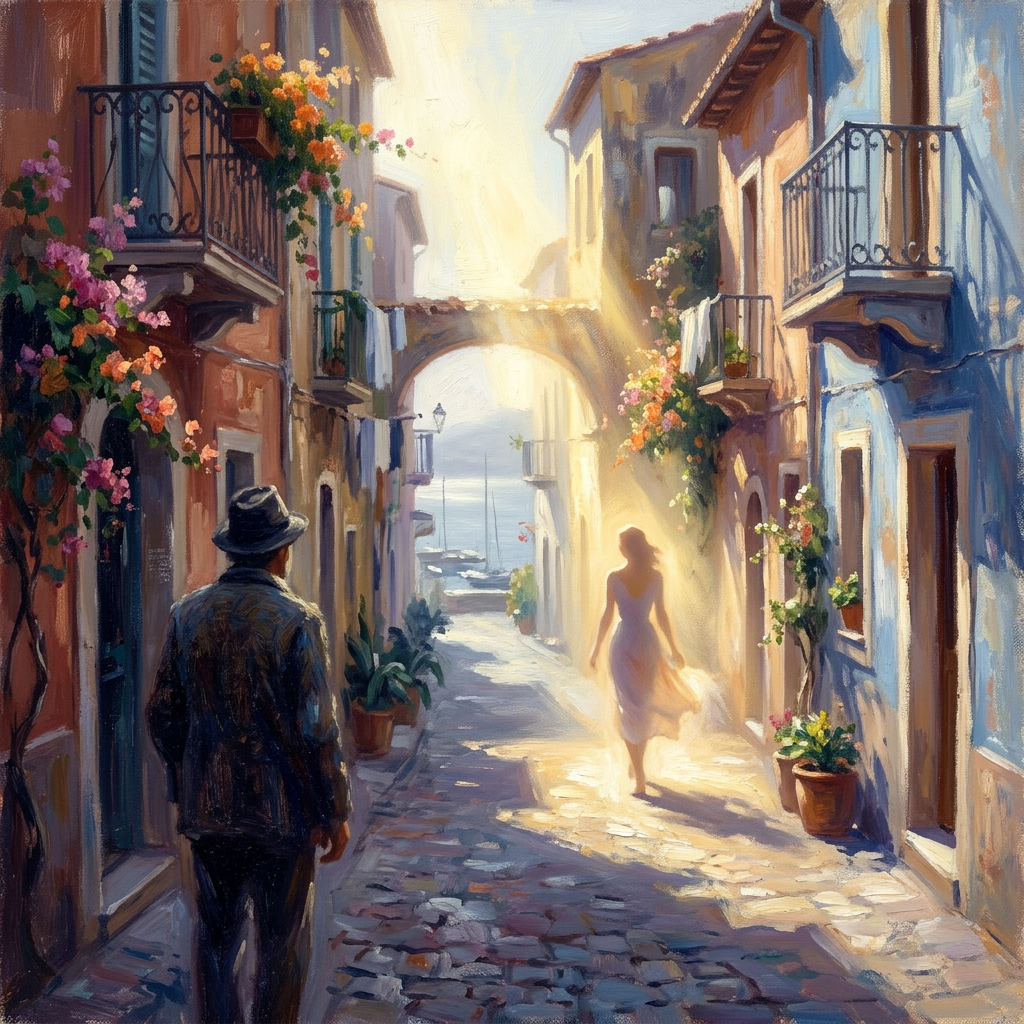
I love beauty. I often have a phrase running through my head when making decisions: follow the beauty. To put it simply, I’m a take-the-scenic-route kind of man.
When it comes to women, though, there’s a fine line between admiration and being a creep. I learned this lesson the hard way with a barista back home who inspired a poem I wrote called Barista of Beauty.
There was a local café in Reading that I frequented, where a beautiful blonde barista with wonderfully blue eyes worked. This was during COVID, so she wore a mask that somehow made her eyes even more striking.
This might sound pretentious, and I rarely tell people this because I don’t want to come across as full of myself, but I believe I’m unusually sensitive to beauty. When I encounter something overwhelmingly beautiful, it hits me harder than I imagine it hits most people.
There is, at least, a psychological concept that helps me make sense of this experience. Openness to experience is one of the five broad personality dimensions in the Big Five model, which psychologists developed through decades of research. The trait is associated with intellectual curiosity, imagination, receptivity to new ideas, and an interest in aesthetics. People who score highly in openness may be especially inclined to engage deeply with art, music, and other aesthetic experiences.
I once took a personality test and scored quite high in openness to experience. That result doesn’t prove I’m more sensitive to beauty than the average man, but it gives me a framework for understanding why certain experiences affect me so intensely.
Some people encounter a piece of art and appreciate it. Others encounter the same piece and feel a shiver run down their spine or find themselves unexpectedly crying. I know what it’s like to be the latter.
When J. Cole dropped his album The Fall-Off, I listened to “39 Intro” five times in a row at one in the morning and started crying tears of triumph and joy purely because of his lyricism. There was nothing sad about the song. I was simply overwhelmed by what I was hearing.
The point is that beauty hits me hard, and when it comes to muses like the barista, I often find it helpful to write something down to get the feelings out of my head.
That’s where I went wrong.
I wrote the poem and thought to myself, I should give this to her.
I didn’t even want to pursue her romantically. I simply thought that if someone were so struck by my beauty that he or she wrote a poem about me, I would want to read it. Surely, I thought, she might appreciate knowing that she had inspired something creative.
So I got some nice paper and carefully transcribed the poem. I even considered how to make it more aesthetically pleasing, eventually using the bottom of a mug to leave a cute coffee stain: a brown circle framing the poem.
Here is what I wrote:
Barista of Beauty,
So much more than the mere
Supply of espresso delight.
She is rather a boundless piece of art,
Of which one glance transfers me
To the realm of the Divine Latte,
Whose aroma of invigorating steam
Seduces me into a serene dream of caffeine.
The most stimulating part of the day,
Such a pity it is to leave
Our gaze of sweet café au lait.
Though I take solace in my gift of
Her delicate toasty fragrance,
Frothy on my yearning mocha lips.
Each sip a vestige of our Beautiful Blend,
Comforts me while I wait to see Her again.
I went in to get coffee, handed it to her, and told her she had inspired it.
She was jubilant. She even gave me a hug.
Not wanting to linger too long, I told her I had to head out and asked her to let me know what she thought when I returned.
A week passed before I decided to visit the shop again.
I entered the café on the corner of Sixth and Penn Avenue, locked eyes with her, and immediately noticed a look of concern and discomfort. She was helping another customer, but I already knew that the interaction ahead was going to be awkward.
Once the customer had moved out of the way, it was my turn to order. I don’t remember what I got, but I remember how little she said. She was quiet and on edge. I was already defeated, and I didn’t have the heart to ask what she thought of the poem.
Eventually, I got my drink and left without another word.
Not long afterward, she stopped working there. I never saw her again, and I still don’t know exactly how she felt about the poem. I can’t know for certain that she disliked it, but her discomfort made me realize that what I had intended as a gesture of appreciation had not necessarily felt that way to her.
To this day, that coffee shop feels strange to me. It broke my heart to see that look of discomfort in those beautiful eyes.
I’ve never pulled that stunt again.
Of course, the negative outcome came from a sample size of one, and I know better than to treat a single experience as a universal rule. I’ve shared poems with other muses, and those experiences have gone well. But those were people I already knew and with whom I had genuine relationships. The circumstances were different from the transactional interaction I had with the barista.
I’m perfectly content to remain a secret admirer of the beauty at Patty and Frank’s.
While waiting for my food, I took the opportunity to practice mindfulness. I sat on the barstool and absorbed the scene around me: the small stand, the grill and its master, the fryer, and the three-compartment sink that my inner SPD technician couldn’t help appreciating. Every so often, I stole a quick glance at the cashier’s beautiful face and that elegant ponytail.
I was the only person waiting for an order, so I could appreciate the care the chef put into preparing my sandwich. I normally dislike watching someone prepare my food because I’ve been on the other side of that experience. It reminds me of those stressful moments in grade school when a teacher would walk down the aisles during a test and stop beside your desk to inspect your progress.
Still, I watched as he worked. Every step felt authentic to the chopped cheese, especially the generous amount of sazón seasoning he used.
When my food was ready, I thanked the cashier with a smile. Our eyes met one last time, and then I went about my business outside, settling at the yellow table.
The chopped beef and cheese was perfect. No notes from me.
As I sat there, the sun emerged from behind the clouds and began punishing my decision to eat a calorie-dense, beefy meal outdoors. Sweat trickled down my back. Then the yellow butterfly appeared in my line of sight, fluttering higher and higher into the sky.
I told myself that maybe I was in the right place after all.
I decided to stay put, laboring through the long roll of a sandwich while the herby lemonade offered some reprieve from the heat. And as I sat there, watching the butterfly disappear into the sky, I thought it might be time to give her a name.
I shall name her Malena. A reminder to follow the beauty, but never mistake admiration for possession.


Leave a Reply