
May 26, 2025
Saying goodbye to my mother is the hardest part. In a fourteen-year span, she birthed three sons and one daughter. Though my sister took away the title of youngest in 2001, I am still my mother’s baby boy. It’s a rather cruel prank, considering that she’s the one who introduced me to the world of sterile processing seven years ago. She encouraged me to apply, and her buddy Ruben, a liaison for the operating room, put in a good word for me with the sterile processing department, better known as SPD. I’ve always liked the acronym because it makes us sound like the police. In a way, we are. Only instead of policing crime, we police bioburden.
As I prepare to leave for Rhode Island, I can’t help thinking about the place where it all began: Reading Hospital, where my mother works as a housekeeper for the OR. The hospital is a pretty big deal for Reading as it is one of two of the largest employers in the city. Mami takes tremendous pride in her work and would tell you she’s the cream of the crop when it comes to housekeeping. I never quite took her claims at face value. Dominicans have a way of exaggerating their own importance. But when I started working at Reading Hospital in January 2018, I quickly learned that Mami stood on business.
“Oh, you’re Miriam’s son! She’s the best!”
I heard some variation of this from practically everyone who knew her at the hospital. Apparently, the woman I knew as my mother had quite the reputation.
I was hired for the evening shift, the same one Mami worked. We were lucky that the hospital was only an eight-minute walk from home, but first I had to complete my orientation on the morning shift, so I didn’t get to walk to work with her just yet. There was about a thirty-minute overlap between the morning and evening shifts, giving us time to pass along any necessary information. Several weeks into the job, during this brief window, I got my first chance to see her at work.
My department sat directly beneath the OR. I was only an elevator ride away from saying hello to Mami. SPD had two separate elevators leading to the operating rooms: one for Core A and another for Core B. Core A was home to operating rooms 1 through 11, while Core B housed rooms 12 through 24. Mami was responsible for keeping Core A clean alongside her partner in crime, Radcliffe, a Jamaican car enthusiast who loved keeping tabs on what car everyone drove.
Ruben was on the floor. I could usually tell he was nearby from the trail of cologne he left behind and his loud Boricua voice, which reminded me of Fidel Castro. He spotted me and came over as if he were on a mission.
“You want to see your mom?! Let’s go, vamos!”
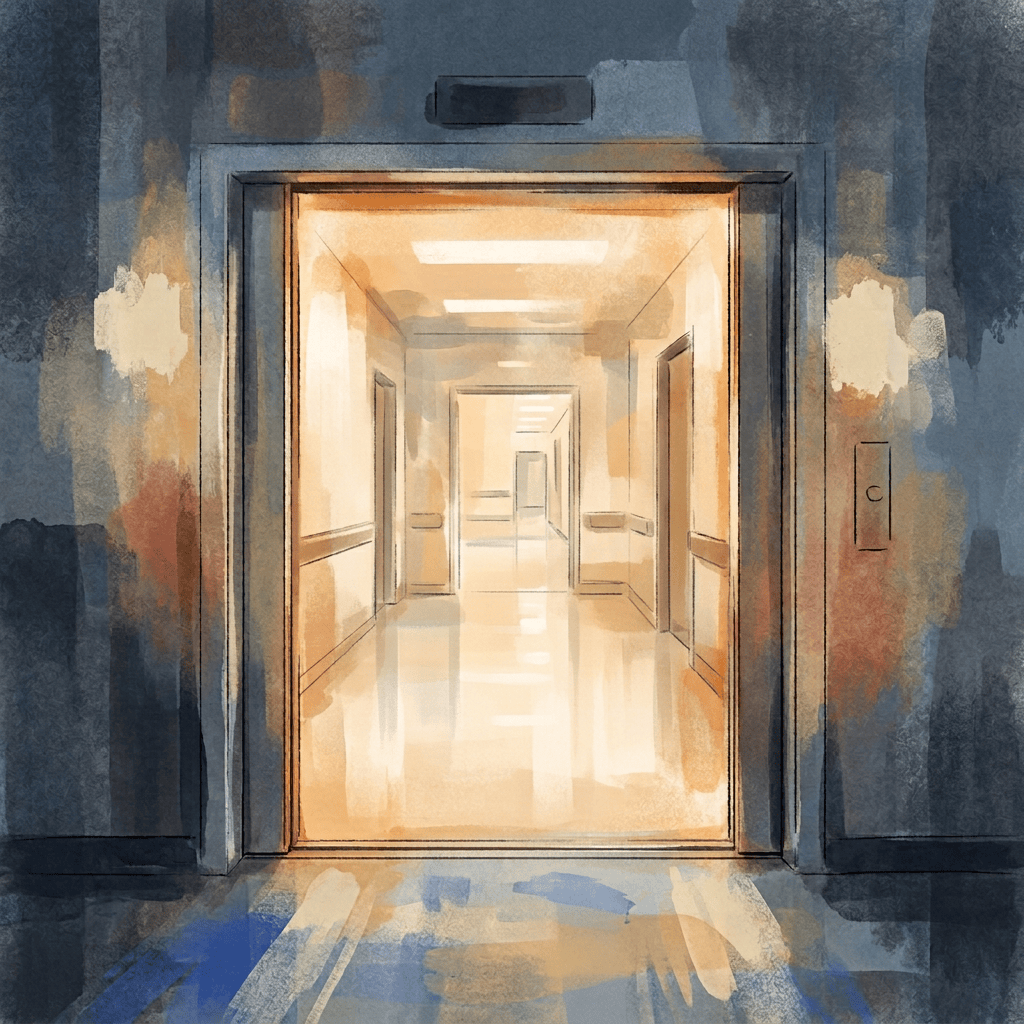
We took the Core A elevator because Mami was cleaning OR 4. SPD was located two floors underground, on a floor called SLL, or sub-lower level. Ruben pressed the button for LL, the lower level.
Walking into the ORs made me uneasy. Amid all the million-dollar technology and million-dollar minds at work, I felt like I didn’t belong. The OR would call our department whenever a tray of instruments was needed, and we would deliver it. The process involved putting on a mask and stepping into the universe of an ongoing surgery.
Sometimes the atmosphere was surprisingly chill. Other times, I walked into what felt like an otherworldly production, the lights tinted green as if I’d entered some strange laser tag arena, or da Vinci robots looming over the patient, their surgeons controlling them like characters in a video game. And then there were the cases that resembled a war zone, with mallets pounding and power drills serving as ammunition.
Every tray delivery brought an instantaneous rush of imposter syndrome. I felt like a courier delivering a tool to a room full of technicians in the middle of defusing a bomb. I had no idea what was happening, but I knew the stakes were high. I was deathly afraid of impeding the operation with some careless misstep, like breaking the sterile field. I wanted to do my job, deliver the instruments, and disappear without disturbing the delicate choreography unfolding around me.
Even now, after years in the field, I never quite get comfortable in those rooms. But on that particular day in 2018, there was no surgery underway.
I pushed open the door to OR 4, and there she was.
Mami was dressed in blue scrubs and a bouffant, smiling at her son, who was dressed in the same attire and working what she felt like was a real job for the first time. For all my years as a certified momma’s boy, I had never quite appreciated my mother’s beauty the way I did in that moment. Perhaps it was because I was seeing the most familiar face in my world, the number one source of unconditional love throughout my twenty-three years of life, in a room that normally intimidated me. Whatever the reason, she was the absolute cutest person in the entire hospital.
Standing beside us, of course, was Ruben, the man who had made this moment possible in more ways than one.
I didn’t quite notice it at first because I was too busy looking at my mother, but Ruben turned out to be the most teary-eyed person in the room. Mami later told me that he had lost a son years ago and that nobody had ever found out what happened to him. His son was presumed dead, but nothing had ever been confirmed. I could only imagine what it must have been like for Ruben to witness a mother and her son sharing such a tender moment. Perhaps it was beautiful for him. Perhaps it was heartbreaking. Probably both.
That poor man.
It was a beautiful thing to inhabit the world my mother called her second home. It always struck me as strange to realize how much time the people I loved spent at their jobs, often inhabiting entire worlds that remained a mystery to me. I had grown up around my father’s work at a bodega in Queens, New York, called La Perla Grocery, occasionally helping break down boxes or working the cash register before I was even a teenager, so there was little mystery there. But Mami had been working at Reading Hospital for more than a decade, and until then, her professional world had remained largely hidden from me.
For more than three years, I walked to work with my mother every day. It’s a routine I’ll always hold dear. We got to walk and talk twice a day, sharing those little pockets of time that didn’t seem particularly extraordinary until I realized how much I’d miss them. I’m also sure she appreciated having a man escort her home at 11:40 p.m. every night.
Neither of us knew that the job she helped me secure would eventually lead to this moment: her youngest boy saying goodbye as he set off for the mysterious state of Rhode Island, all by himself.
It’s around eleven in the morning. The sky is sunny but dotted with clouds, and it’s time to go.
Mami gives me one final hug and launches into her usual collection of blessings, warnings, and declarations of love. The goodbye takes longer than necessary, as it always does. She has an endless supply of things to say:
“Que Dios te bendiga.”
“Que te me cuides.”
“No manejes muy rápido.”
“I luv u berry much.”
And on and on.
I take it all in. How could I not? These are the little rituals of being someone’s son, and I wouldn’t trade them for anything.
The only solace in this bittersweet moment is the road ahead. There’s a new adventure waiting for me, and I need to get moving before sentimentality convinces me to stay.
I climb into Juvia, press the brake, and push the start button. The engine comes to life. I set my Google Maps to the hotel where I’ll be staying in Providence, Rhode Island. The ETA reads five hours and forty-five minutes. I pull away and begin heading north.
As I drive, my thoughts turn to my elders, who immigrated from the Dominican Republic to New York City during the 1970s. Life was far more chaotic for them. They arrived without knowing a word of English, leaving behind everything familiar to build a life in a foreign country, armed with little more than whatever they could carry and the hope that things would work out.
Surely, Providence will be a cakewalk compared to that.
At least, that’s what I tell myself as I hit the road.


Leave a Reply