
Nostalgia is a fucking scam.
I’ve been going through a phase of watching old films like Richard Linklater’s Dazed and Confused and Terry Gilliam’s Brazil, both of which have helped me articulate a feeling I’ve had lately: why has my adult life lost some of the magic of childhood?
Nostalgia is booming among Millennials like myself. Pokémon cards are more lucrative than ever, old games are constantly being remade, and even baggy jeans are back in style, a trend I refuse to participate in. But what exactly are we trying to recapture?
Watching Dazed and Confused, I felt the pull of nostalgia, but I also noticed how little of the actual lifestyle I wanted back. The characters drink, smoke, drive recklessly, haze one another, and generally behave like teenagers. Brazil, on the otherhand, presents a dystopian bureaucracy that feels remarkably relevant decades later. One detail of Gilliam’s 1985 film struck me most: its characters are constantly transfixed by little television screens, using media as an escape from a mundane reality.
That felt familiar.
The World I Came From
As a Millennial born in 1994, I grew up during a strange historical window. My childhood came before the internet completely took over daily life.
My childhood was filled with boredom because stimulation was harder to come by. I couldn’t watch whatever I wanted on Netflix. I had to wait for the one television in our house to become available and then watch whatever the TV gods decided to give me.
Eventually we got a Compaq computer with AOL dial-up, but even that was limited. I had two older brothers competing for internet time, and our session could end abruptly if my mother needed the phone line.
Music was similarly scarce. I remember my brother lending me an MP3 player in the sixth grade loaded with hip-hop. I listened to Big Pun and the Notorious B.I.G. relentlessly because that’s what I had. Later, I discovered LimeWire and vividly remember illegally downloading Eminem’s Stan and hearing it for the first time, forever altering my brain chemistry.
The important thing isn’t the piracy or even the technology. It took time, luck, and effort to gain digital agency.
The internet was once an exclusive club. You hoped the bouncer would let you in. Today, the problem is almost the opposite: the bouncer never lets you leave.
That transformation happened gradually. What was once a place we deliberately entered became an environment that follows us everywhere. The internet used to require a decision: sit down at the family computer, wait for the dial-up connection, log on, and go online. Now, there is rarely a moment when we are truly offline. The internet sits in our pockets, fills the empty spaces between activities, and increasingly competes for our attention whenever there is nothing else demanding it.
The word doomscrolling captures something that would have sounded almost absurd when I was a child: endlessly consuming an infinite stream of information, entertainment, outrage, and novelty, even when we know it is making us feel worse. Sometimes I have closed my TikTok app and opened it right back up out of pure conditioning. I can’t ever remember naything like that being the case as a kid. I can’t imagine turning off the TV and subsconsciously turning it back on to see what was on.
I was reminded of this after a long day at work. I looked around and noticed my coworkers almost immediately retreating into their phones. Some went straight into the endless loop of Reels or TikTok. Everyone seemed to have somewhere else to go, even though we were all sitting in the same room.
For a moment, I felt like I had stepped into Gilliam’s world.
It wasn’t that anyone was doing anything particularly wrong. I was struck by something more unsettling: how normal it had become. The moment there was a little empty space, something rushed in to fill it. We no longer seemed to tolerate boredom long enough for boredom to become anything else.
And I realized that this might be the thing I have actually been mourning.
Maybe I don’t miss childhood itself. I miss the conditions that surrounded it: the scarcity that created anticipation, the boredom that forced curiosity, the limitations that made discovery feel meaningful, and the stretches of uninterrupted time in which my attention belonged entirely to whatever was in front of me.
And that led me to a question:
What if what I miss about childhood isn’t childhood, but the way the world used to make me experience time, attention, boredom, anticipation, and discovery?
The World I Inherited
My teenage years were a blur of personal development and technological change. One moment, my summers were filled with the local swimming pool, biking, backyard sports, and split-screen gaming on GameCube and PS2. Then suddenly I was carrying a Samsung Galaxy, relentlessly checking Facebook and Twitter, religiously keeping up with my favorite YouTube creators, breaking night on Xbox Live, and discovering a virtually limitless world of pornography.
It happened incredibly fast.
I cherish many of those memories. Late adolescence is an incredible period of life when your identity is still forming and almost anything seems possible. But looking back, I have mixed feelings about how much of those formative years were spent online.
The digital world felt innocent then. Now we’re living inside an attention economy saturated with misinformation, ragebait, AI-generated content, advertisements, subscriptions, microtransactions, gambling, predictive markets, and platforms competing relentlessly for our attention. Even my electric toothbrush wanted me to download an app and create an account.
It all feels heavy.
But I’ve recently realized something important: I don’t have to live this way.
Technology didn’t force us to create this environment. Our collective choices helped create it, and that means individual choices can shape our relationship with it.
Reclaiming the Old Magic
I don’t want to abandon technology. I love technology. It helped shape me. But it is increasingly dominating my life, and I don’t like the relationship I’ve developed with it.
I think Millennials have approached nostalgia incorrectly. We keep buying the artifacts of our childhood without recreating the conditions that made them meaningful. We buy the Pokémon cards, the baggy jeans, the old video games and the retro consoles. But the magic wasn’t necessarily in those objects.
It was in boredom, anticipation, mystery, deep attention, patience, wandering, privacy, slowness, and limitation.
Boredom is severely underrated.
I can’t count the number of things I learned simply because I had nothing else to do. I taught myself to ride a bike, juggle, cook eggs, and play Minesweeper. I built domino towers and pillow forts. I literally used to spend time organizing a deck of cards by number simply because I was bored.
The activities themselves aren’t particularly important. The conditions were.
A bored child has to become curious. What happens when that child has an iPad full of infinitely stimulating games and videos instead? What happens when every moment of silence can be filled with a scroll?
Perhaps we lose some of our capacity to discover what emerges when nothing is demanding our attention.
Less Is More
My first step has been eliminating most of my media subscriptions.
No Netflix, Crunchyroll, Amazon Prime, HBO, Disney+, Spotify, Apple Music, or YouTube Music.
This isn’t because I think these services are evil. I’m simply tired of having an infinite buffet of entertainment available at all times. (It certainly helps my bank account though.)
I miss scarcity.
I miss having a handful of songs or movies that became like old friends because I replayed them endlessly. I miss getting my hands on a DVD like Stepbrothers and watching it multiple times in a day because it was amazing and not mine to keep. I miss saving money for a $20 used game at GameStop and playing it until I knew it by heart because there wasn’t much else to play.
Unlimited choice sounds like freedom, but sometimes it makes commitment harder.
There’s an obvious parallel to online dating: This person is pretty good, but what if someone better is one swipe away?
I explored a similar idea in my previous post, Is America Too Cultured? I argued that American life can become overwhelmed by cultural abundance. We have access to more cultures, foods, entertainment, information, and lifestyles than we could possibly experience meaningfully. Digital entertainment takes that excess to another level.
Imagine walking into a museum containing every great painting ever made. You could walk from Van Gogh to Picasso to Monet in seconds. If a painting doesn’t immediately grab you, you simply move on.
Would Starry Night hit you the same way? Would you even linger?
That’s what concerns me about infinite music and television. When everything is available, nothing has to be endured long enough to become meaningful. Scarcity creates commitment. Commitment creates familiarity. And familiarity can create appreciation.
Building My Garden
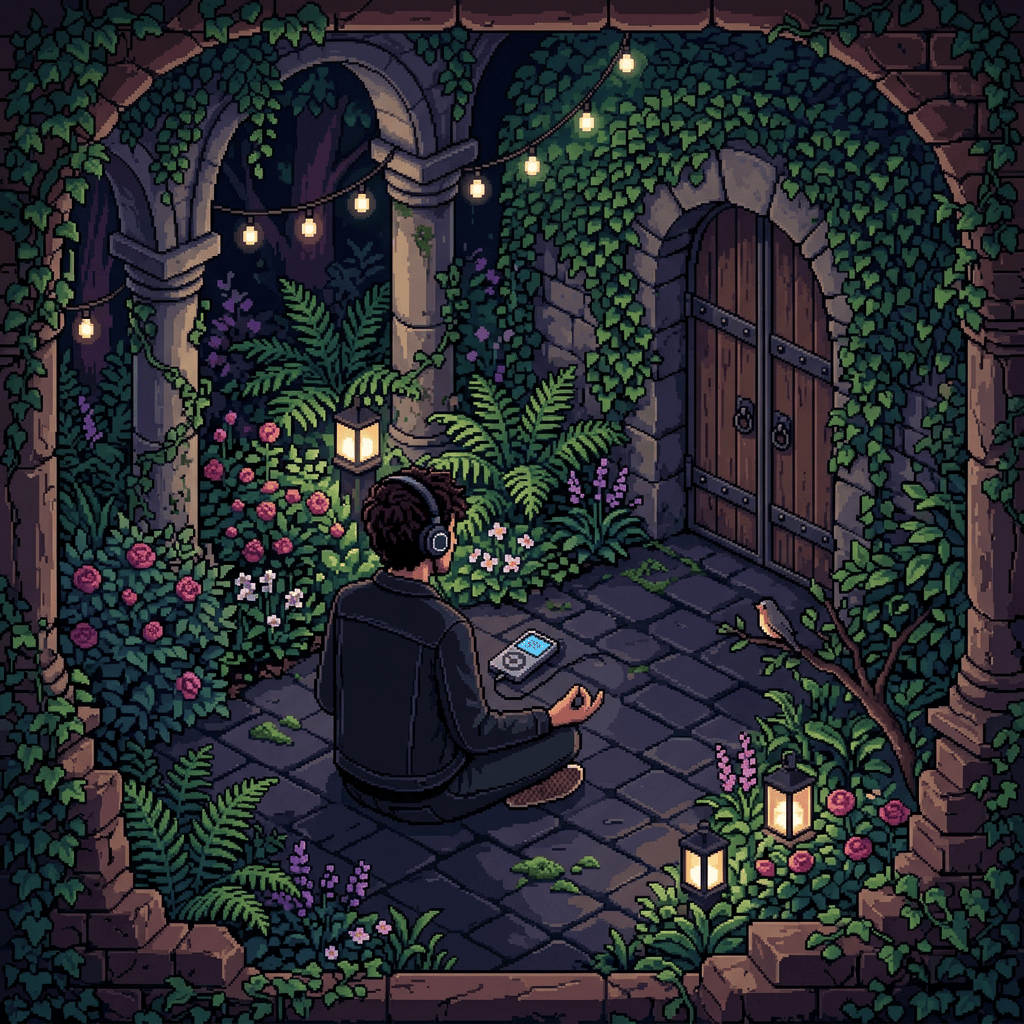
I am over the digital club life. I want to leave it behind and build something of my own: a digital world more akin to a garden.
A garden doesn’t give you everything at once. You decide what belongs there, what needs to be removed, and what deserves your attention. It requires cultivation. It has boundaries. Most importantly, you are the one tending to it.
I’ve started by renting movies individually rather than maintaining streaming subscriptions. Surprisingly, I’ve become much more efficient at choosing what to watch. I’m no longer scrolling through an enormous catalog trying to determine which of a thousand options is the “best” use of my time. I pick a movie, watch it, and move on.
With music, I’m going even further.
I plan to buy an MP3 player and return to something resembling the old ritual of owning albums.
I remember working at FYE and buying CDs. There was something satisfying about walking out the store with a new album, struggling to open that ridiculous plastic case, putting the CD into my mother’s Kia Sportage, and beginning the journey.
There was anticipation.
I didn’t wake up on Friday morning, open Spotify from bed, and immediately enter an infinite digital landscape.
An MP3 player gives me some of that ritual back without requiring me to abandon digital music. I can choose what I own, separate music from my smartphone, and listen without advertisements, algorithmic playlists, recommendations, autoplay, and everything else competing for my attention.
Most importantly, I control the environment.
Of course, this experiment has drawbacks. An MP3 player is another device to manage, and I could end up stuck with a terrible album taking up space on my hard drive. But that’s part of the point.
I want some friction back.
I want to make my entertainment finite enough that I have to live with my choices. I want to give things enough time to grow on me. I want to rediscover the strange pleasure of having fewer options and finding out what I can do with them.
A Different Kind of Future
I don’t want to return to the 1990s.
I don’t want to give up GPS, smartphones, instant communication, digital music, streaming movies, or the incredible amount of knowledge technology has placed at our fingertips. I simply want to stop allowing convenience to dictate how I experience everything.
My garden won’t be a rejection of technology. It will be a place where technology has to earn its place. Some things will stay. Some things will be removed. Some things will be deliberately limited. And, most importantly, there will be enough empty space for something unexpected to grow.
I’m not trying to become a Luddite. I’m trying to build a digital life that serves me rather than one that constantly asks me to serve it.
Maybe the magic of childhood wasn’t that the world was better. Maybe it was that the world had enough limitations to force me to participate in it.
And that’s what I want back. Not childhood.
I want boredom without immediately reaching for my phone. I want anticipation instead of instant gratification. I want to discover things instead of constantly being recommended things. I want to sit with an album, a movie, a book, a walk, a conversation, and let it become meaningful through sustained attention.
The goal isn’t to go backward. It’s to take what was valuable from the world I came from and bring it with me into the world I inherited.
Maybe the old magic was never in the world at all. Maybe it was what happened when the world stopped giving me everything, and I was finally left with enough space to discover something for myself.


Leave a comment